
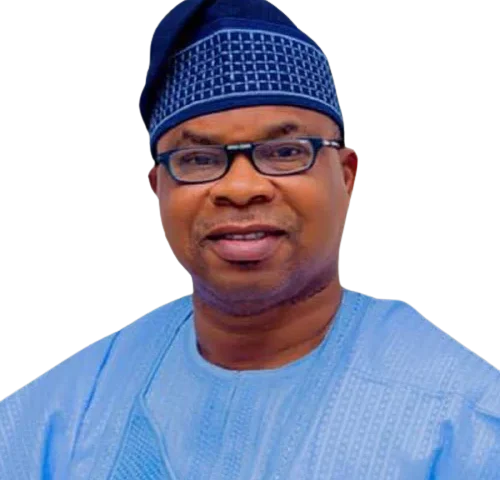

Picture: Oyebamiji
By Foster Obi
The emergence of the immediate past Managing Director of the National Inland Waterways Authority (NIWA), Mr. Bola Oyebamiji, as the consensus governorship candidate of the All Progressives Congress (APC) in Osun State has thrown up a contest layered with power, precedent, and political irony.
Oyebamiji is not just another technocrat-turned-politician. He is widely seen as one of President Bola Tinubu’s trusted hands, a perception strengthened by his smooth sail to the APC ticket. Yet, his entry into the Osun governorship race also reopens old political wounds for the ruling party at the centre, especially given the complicated history between Tinubu’s political camp and the incumbent Osun governor, Ademola Adeleke now flying the flag of the Accord Party.
Oyebamiji’s tenure at NIWA provides the clearest window into how he may govern Osun, if elected. Appointed at a time when the inland waterways sector was mired in regulatory overlaps, institutional rivalry and insecurity, his leadership focused on asserting NIWA’s statutory authority, particularly over inland ports and waterways infrastructure.
Under his watch, NIWA pushed aggressively to reclaim and regulate inland waterways from state encroachment, often putting the agency on a collision course with powerful subnational actors. Supporters hail this as courage and fidelity to federal law; critics describe it as combative centralism that sometimes prioritizes authority over consensus.
There were visible gains: increased attention to inland water transport, renewed interest in barge operations, and attempts, however uneven, to improve safety standards and revenue remittance.
Yet, the NIWA years were also marked by controversies, including disputes with coastal states and lingering questions over how much of the promised inland waterway revolution truly reached everyday users.
For Osun voters, the question is simple: does a record forged on rivers and ports translate into leadership on land, on roads, schools, healthcare and jobs?
A Tinubu Man in a the eye of the storm:
Politically, Oyebamiji enters the race with the full weight of the APC’s national machinery and, crucially, the perceived backing of President Tinubu. In Osun, that matters. The state remains one of the symbolic battlegrounds of South-West politics, where Tinubu’s influence has been tested, and bruised in recent years.
That bruising came most notably through the defeat of the immediate past Osun governor, Adegboyega Oyetola, now Nigeria’s Minister of Marine and Blue Economy and a cousin of the President. His loss to the current governor, who has since decamped to the Accord Party, remains a painful reminder that federal might does not automatically translate to electoral victory in Osun.
This is the irony Oyebamiji must navigate. He benefits from Tinubu’s support, but he also inherits the burden of Tinubu’s last political loss in the state.
The incumbent governor’s defection to the Accord Party adds another layer of unpredictability. Stripped of a major party platform but armed with incumbency, grassroots structures and a tested voter base, he represents a different kind of challenge.
Incumbency in Osun has historically been a powerful weapon. Control of local networks, visibility through governance, and the ability to frame the election as continuity versus uncertainty could play strongly in his favour, especially if the electorate views the APC as recycling external influence rather than offering a fresh social contract.
Oyebamiji’s challenge will be to avoid being branded merely as “Abuja’s candidate” or “Tinubu’s man,” and instead convince voters that his technocratic background equips him to fix Osun’s peculiar problems.
What the race may bring:
Ultimately, the contest may not hinge on party logos alone, but on narratives:
On the side of APC: competence in the face of a bleeding economy and beleaguered populace, federal alignment, and a promise to plug Osun into national development pipelines.
On the side of the Incumbent: experience, continuity, and resistance to external political dominance.
Oyebamiji’s NIWA record gives him an image of discipline and administrative firmness. Whether that image resonates with market women in Ilesa, farmers in Iwo, and civil servants in Osogbo is another matter entirely.
As Osun heads into another defining election, the state may once again test a familiar proposition of Nigerian politics which is, Can technocracy, backed by federal power, defeat incumbency rooted in local loyalty?
For Bola Oyebamiji, the rivers he once regulated may prove easier to navigate than the political currents now ahead.

