

By Foster Obi
Governor Alex Otti yesterday placed Abia State firmly on a long-term development path, unveiling a legally binding 25-Year Development Plan that will guide governance, spending, and growth priorities up to 2050, while declaring the state “a new development frontier” in Nigeria’s evolving macroeconomic landscape.
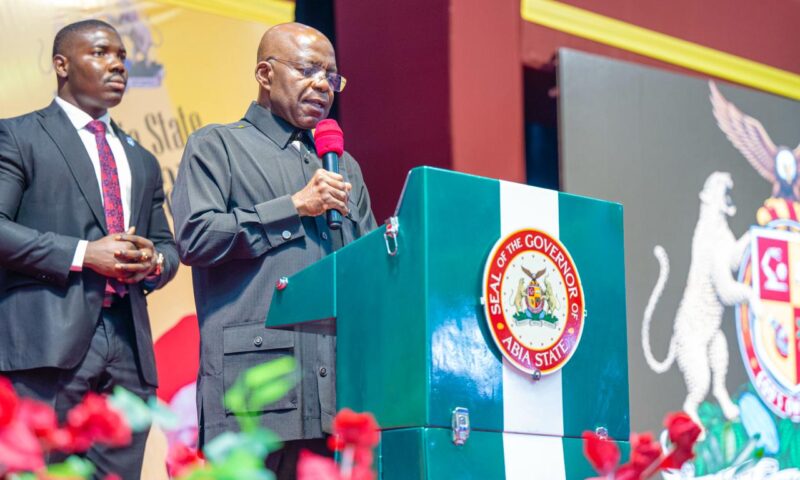
Speaking at the International Conference Centre, Umuahia, Otti said the future Abia seeks “will not happen by chance,” insisting that disciplined planning, rather than political improvisation, was the only shield against uncertainty in an era of global economic shocks.
Quoting Lewis Carroll and Benjamin Franklin, the governor warned that societies that fail to plan “are already planning to fail,” adding that the newly unveiled blueprint was not a utopian wish list but “a realistic framework against which policies, budgets, and leadership choices will be judged.”
“This plan is not an imaginary El Dorado by 2050,” Otti said. “It is a holistic development framework that captures where we are, where we want to be, and the decision pathways required to get there.”
Why a new plan:
Otti explained that Abia’s earlier 30-year plan, launched in 2020, had become outdated, overtaken by sweeping changes in local and global economic fundamentals, landmark legislations, constitutional adjustments, and the policy direction of the new federal and state administrations.
More critically, he said, Abia’s own rapid progress over the past 30 months had rendered many old assumptions obsolete, demanding a recalibration of the state’s long-term economic architecture.
“Expectations are higher, optimism is rising, and confidence in Abia is growing both locally and internationally,” he said, pointing to the presence of global development partners as evidence of renewed trust in the state’s economic direction.
A plan with teeth:
In a clear departure from past development documents that gathered dust after launch, Otti disclosed that the 25-year plan has been anchored in law by the Abia State House of Assembly, making it binding on successive administrations.
“What we are unveiling is more than a proposal,” he said. “It is a binding law that this administration and those to come are obliged to follow.”
Under the framework, annual budgets from the 2026 fiscal year will be drawn directly from the plan, while comprehensive reviews will be conducted every five years to measure progress, correct lapses, and recalibrate projections in response to major socioeconomic disruptions.
The plan sets milestones across education, healthcare, infrastructure, housing, transport, water and sanitation, environmental sustainability, and institutional capacity building.
Self-sufficiency agenda:
Otti also linked the development roadmap to Abia’s fiscal strategy, announcing a bold target to achieve self-sufficiency in recurrent expenditure beginning in 2026 through stronger internally generated revenue (IGR).
The governor said Abia aims to fund salaries, pensions, and routine government operations entirely from internal revenue, while channeling all external inflows into capital projects.
“As we deliver impactful infrastructure, productivity will rise, assets will unlock value, and public revenue will grow,” he said, expressing optimism that within a decade, Abia would rely far less on external allocations.
Global confidence, local ownership:
The governor paid glowing tribute to the Abia Economic Management Team, the Abia Global Economic Advisory Council (AGEAC), co-chaired by Prof. Arunma Oteh, Emir Muhammadu Sanusi, Bolaji Balogun, and Ifueko Okauru, as well as development partners including UNDP, PIND, PACE, and PwC for shaping what he described as a people-owned plan.
“This is not the ideas of a few eggheads,” Otti said. “It reflects the collective aspirations of the Abia community and makes room for future generations.”
“The future is now mapped”
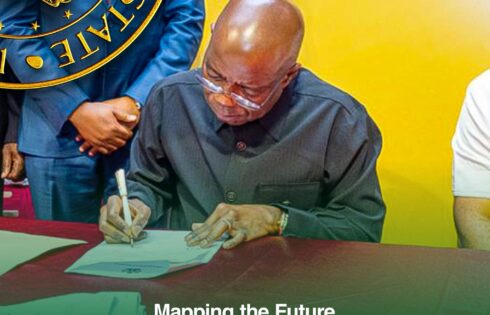
As he formally unveiled the document, Otti urged citizens to see the plan as a collective covenant rather than a government proclamation.
“The New Abia project is our shared responsibility,” he said. “All that is required of us is to believe and do our part.”
With the blueprint now in place, the governor declared, “The future of Abia is mapped.”

