By Chinedu Agu
I arrived in Umuahia in the afternoon of 23 January 2026 for the Quarterly Meeting of the Eastern Bar Forum (EBF), held from 23–25 January 2026. I was privileged to serve as the Compère for the Cocktail on Thursday, the Opening Ceremony on Friday morning, and the Dinner on Friday evening. The duties were demanding, the atmosphere, electric, and the gathering memorable. Yet, beyond the microphone and formalities, the true high point of that weekend for me was the EBF Governor’s Tour of Abia projects.
Upon arrival, the Honourable the Attorney-General and Commissioner for Justice of Abia State, Ikechukwu Uwanna, SAN, received the EBF Governor, D O. Nosike, and members of the Forum in his chambers [including me]. From there, he personally led us on a tour of ongoing projects undertaken by the Abia State Government.
What I saw did not merely impress me. It unsettled me not because I am allergic to progress but because of where I came from.
Our first stop was the Ultra-Modern Umuahia Central Bus Terminal, located right in the city centre. I know when something is local improvisation and when it is global thinking executed locally. In this case, it was the latter.
This terminal looks and will function like an airport. Inside, it is a hotel deliberately built for travellers who arrive late or need to catch early departures. There are eateries, ticketing halls, arrival lobbies, automatic stairways, and a large surveillance control room fitted with over twelve monitoring screens covering the entire terminal and its environment.
Without exaggeration, the only places I have seen anything comparable are Victoria Coach Station in London and Nottingham Broadmarsh Bus Station. This is the first of its kind I have seen anywhere in Nigeria.
From there, we on-boarded the Electric Vehicle Green Shuttle buses designated for the terminal. One of them conducted us for the rest of the tour.
The bus was fully electric, noiseless, brand new, and manned by a highly professional pilot, co-pilot, and crew. Inside were air-conditioning, TV screens, spacious seating, waste disposal systems, and an overwhelming sense of calm. Like the Abia Governor, you do not hear the engine. You just feel its progress.
As we moved through Umuahia, one thing was consistent: smooth roads. No excuses. No detours. No apologies.
The bus took us to the Isiala Ngwa High Court at Umuene, an ultra-modern High Court complex commissioned on 29 October 2025. Solar-powered. Digitized. Secure.
The exhibit room is built like a bank vault, a deliberate lesson learned from the destruction of public facilities witnessed during the #EndSARS protests. Courtrooms are fortified, functional, and future-facing.
According to the Attorney-General, one such High Court is being constructed in every Local Government Area, to be completed by the first quarter of the year. Immediately after, 17 High Courts each will be built in Aba and Umuahia, commencing in the second quarter.
Justice here is not a slogan. It is concrete, steel, solar panels, and software. Aba is rising again!
We proceeded to Aba, where contractors were already fully mobilised on similar court projects.
But Aba today is more than construction sites: cleanliness has returned, orderliness has returned, nightlife has returned, road connectivity has returned!
As these things are happening in Umuahia, even more is unfolding in Aba. Abia is not developing one city to impress visitors; it is rebuilding an entire state.
The EBF events were held at the Michael Okpara Auditorium, a structure abandoned by previous administrations. Today, it stands elegant, functional, and worthy of regional gatherings of this magnitude.
During the vote of thanks, the Attorney-General was commended by the EBF Governor for exceptional hosting and hospitality. He remarked with justified pride that we have not had an EBF like this in recent times.
I added, half-joking but fully honest: “That is because we have not had an Abia this good in a long while.” The hall exploded in pearls of laughter and applause. But the truth stayed seated.
For context, let me now tell a story.
There was a boy who consistently came last in his class. One day, his mother could no longer contain her frustration. She rebuked him and asked why he kept failing, why he kept allowing his classmate, Peter, to beat him every term.
The boy replied defensively:
“Mummy, Peter is far older than me. His father is a professor. His mother is a school principal. His uncles are professors. His siblings are teachers, lawyers, and doctors. How do you expect me to compete?”
The excuse sounded intelligent. It even sounded convincing. But his parents were not persuaded. Instead, they stepped him down by one class, hoping he would stabilize.
In the new class, another boy emerged, Alex. Alex beat him again. Worse still, Alex was much younger. His father was a mechanic. His mother was a food vendor. His siblings were okada riders. His uncles were timber cutters and carriers at the Timbre market.
This time, the boy had no excuse. None!
That shame; the kind that strips you of explanations, is exactly where Imo State stands today.
Recently, whenever Imo was compared with Enugu, the official response followed a familiar script: “Enugu has been around longer.” “Enugu was the capital of the old Eastern Region.” “Enugu has historical advantages.”
In this story, Enugu was Peter; older, advantaged, intellectually endowed by history. And a few gullible people accepted that explanation.
But now comes Abia – a historical newbie: born on 27 August 1991; 15 years, 6 months, and 24 days younger than Imo; endured decades of some of the worst leadership experiments since the return to civil rule; receives far less allocation than Imo; has no old regional capital pedigree. Yet today, Abia has overtaken Imo — clearly, quietly, and conclusively.
I think the excuses have evaporated.
Governor Alex Otti did not meet a functioning system. He met rot: unpaid salaries, abandoned infrastructure, broken institutions, demoralized civil servants, and shattered public trust.
He did not spend his time blaming predecessors. He did not govern by press releases. He folded his sleeves and went to work.
Today, Abia has rebuilt critical road networks across Umuahia and Aba; restored Aba as a commercial, clean, and livable city; paid civil servants promptly; cleared pension arrears and restored dignity to retirees; digitized and functionalised the Ministry of Lands without shutting it down for three years; launched massive judicial infrastructure across all LGAs; digitized court processes and records; reimagined public transportation with electric buses and a world-class terminal; revived abandoned public assets; built synergy across justice sector institutions instead of rivalry.
These are not promises.
They are verifiable facts.
Comparatively, Imo did not inherit deeper decay than Abia. It did not face more severe institutional collapse, nor did it suffer greater economic dislocation. Yet the state remains trapped in explanations, blame-shifting, and avoidance.
Where Abia builds courts, Imo debates appointments. Where Abia digitizes justice, Imo weaponizes and politicizes it. Where Abia aligns institutions, Imo allows them to sabotage and arm-twist one another. Where Abia works, Imo explains.
In my story, Enugu was Peter. Abia is Alex. And Imo has lost to both – to both older and younger, punching below its weight!
Governance is not ancestry; it is discipline, competence, and will. States that work do not arrest critics, they outgrow criticism through verifiable and formidable performance. Abia is doing exactly that.
Measuring a state’s success solely by comparing the present administration with its predecessors is the hallmark of leadership myopia. Had Alex Otti done that, he might have focused narrowly on road construction, then told critics: “See, I have outperformed my predecessors; Abians should be satisfied. Call me the Infrastructure Ambassador.”
He did no such thing. Instead, he gauges governance by comparing it with states and countries that work, setting benchmarks that challenge mediocrity, not excuses.
What use is an argument between two dwarfs disputing who is taller? True perspective comes from looking beyond our borders. Otherwise, one risks mistaking oneself for a giant fish in a small pond, or a local champion in a continental contest.
Abia is playing in the Champions League, competing with European heavyweights and winning matches; Imo is stuck in a relegation battle in the Championship.
As I disembarked from the EV Green Shuttle Bus, one thought stayed with me: History will not read statements. It will read the results.
And right now, Abia has left us behind, sadly.
_Chinedu Agu is a Solicitor and Notary Public | Former Secretary of NBA Owerri | Human Rights and Good Governance Advocate | Former Political Detainee_
+234 8032568512

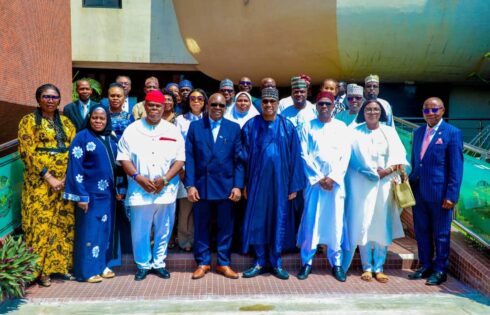 Picture: Group photograph of the Governing Board and Management of Nigerian Shippers’ Council during the inaugural meeting at the Council’s Headquarters, Lagos